Autocrypt Demonstrates EV PnC PKI Service, Says Charging Can Start With Vehicle Authentication Alone
TECHWORLD ·
✦ Resumen de IA
Autocrypt held a Public PnC PKI Service Demonstration at the Korea Electrotechnology Research Institute’s demonstration test building.
The demonstration checked core PnC functions based on automatic vehicle-charger authentication and charging without separate card or app authentication.
Autocrypt built a public V2G root CA-based PnC PKI system and is pursuing expanded OEM and CPO integration.
Autocrypt demonstrated its EV PnC(Plug & Charge) PKI service. The event was aimed at checking whether vehicle authentication and charging could be linked based on a national common certification framework, and it pointed to the commercialization potential of a public PnC service.
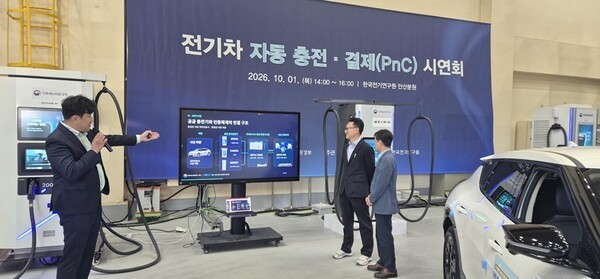
On the 1st, the "Public PnC PKI Service Demonstration" was held at the Korea Electrotechnology Research Institute’s demonstration test building. Officials and companies from the Ministry of Climate, Energy and Environment, OEMs, and CPOs attended the event.
The purpose of the demonstration was to verify the entire process before a public commercialization service for the general public. The verification target was the core PnC function based on automatic vehicle-charger authentication, including a charging method that does not require separate card or app authentication.
Autocrypt built a public V2G root CA-based PnC PKI system and demonstrated the process of linking the authentication framework among OEMs, CPOs, and chargers. The charging procedure started when a vehicle was connected to a charger, triggering automatic authentication based on authentication information, after which charging began.
The demonstration used major domestic EVs, including the Hyundai GV90, Kia EV9, KGM Musso EV, Mercedes-Benz CLA, Tesla Model Y, and BMW IX3, as well as chargers from EVSIS, SK Signet, and Chaevi. The event was conducted to show the potential for applying public PnC using a range of EVs and chargers.
If public PnC services expand, users will be able to authenticate and charge when connecting to a charger using only the vehicle registration authentication information. If payment and settlement functions are linked in the future, convenience is expected to improve further.
Regarding this, Autocrypt CEO Kim Deok-soo said that PnC goes beyond replacing cards and apps and is a trust infrastructure that enables unmanned mutual authentication between vehicles and charging infrastructure and secure energy exchange in the era of physical AI. He also said Autocrypt will use its public PnC PKI infrastructure to safely connect domestic and global OEMs and CPOs and expand its business into the global PnC PKI market. He added that the company will pursue the creation of a safe charging and energy ecosystem.
With this proof of concept as a turning point, Autocrypt plans to expand its PnC PKI business, with its business direction focused on connecting domestic and overseas OEMs and CPOs. It has completed domestic OEM integration with Hyundai Motor, Kia, and KGM, and is conducting overseas OEM integration and verification for BMW, Mercedes-Benz, and Tesla. It has also established charging-sector integration foundations with EVSIS, SK Signet, and Chaevi, and is also in discussions to build OEM PKI integration with additional overseas OEMs.
Source: TECHWORLD · Kim Hye-jin
Original: https://www.epnc.co.kr/news/articleView.html?idxno=407763
References
This article was produced with the help of an automated content generation algorithm.
Source: TECHWORLD
Ver originalThis article was summarized and organized by BizCrush based on the original article from TECHWORLD. For exact quotations and full details, please refer to the original article.