Lee Hae-min Says He Will Bridge the “Seams” in AI Policy Across Ministries, Strengthen CAIO Council Role
TECHWORLD ·
✦ Resumen de IA
Lee Hae-min, senior presidential secretary at the Blue House for AI future planning, said he would strengthen the CAIO Council into a consultative body that coordinates interministerial AI policy issues and resolves problems on the ground.
The government expanded the council’s attendance target from 28 ministerial-level agencies to 42 central administrative agencies, with 14 vice minister-level agencies newly joining.
At this meeting, participants discussed pan-government AI legislation, preparation for the "AI for All" service, the pan-government data pipeline, public-sector privacy protection, and cooperation tasks.
Lee Hae-min, senior presidential secretary for AI future planning at the Blue House, said he would strengthen the function of the Council of CAIOs. Lee outlined a direction to develop the CAIO Council beyond a simple discussion body into a consultative group that coordinates AI policy issues among ministries and helps resolve problems on the ground.
In line with that, the government expanded the scope of agencies attending the council. The number of participating bodies was widened from 28 ministerial-level agencies to 42 central administrative agencies, and 14 vice minister-level agencies joined for the first time at this meeting. Examples of the newly participating agencies include the Ministry of Personnel Management, the Ministry of Government Legislation, and the National Data Office.
The government made issues that multiple ministries must address jointly into council agenda items. The discussion topics included pan-government AI legislation, public data, personal information protection, and interministerial cooperation.
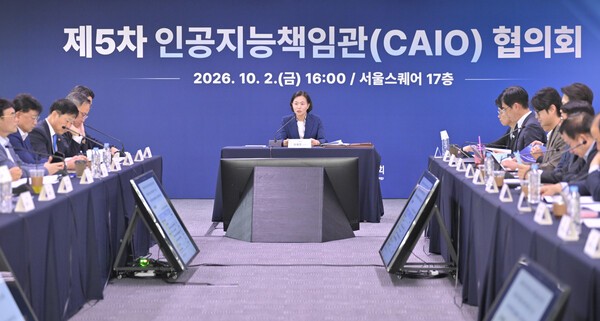
The 5th CAIO Council was held on the 2nd at Seoul Square. Lee said the government has laid the groundwork for interministerial AI policy cooperation through four meetings over the past 2 years, and explained that this meeting expanded the scope of participation in the council. He also reaffirmed that the attendance target had been changed from 28 ministerial-level agencies to 42 central administrative agencies.
Lee emphasized the importance of interministerial cooperation. He said the key point recognized both at corporate sites and in the National Assembly was the importance of connecting ministries. He also noted that there are cases in which delays or slowdowns occur at the interministerial stage even after policy announcements.
Lee explained that the Council of CAIOs takes on the role of connecting ministries. He added that the council aims not to stop at hearing reports, but to resolve issues among ministries and solve problems on the ground. Lee said he plans to directly oversee the council’s functions as chair.
At the council meeting, participants discussed the direction of pan-government AI legislation. They also discussed preparations for the "AI for All" service and a pan-government data pipeline. Privacy protection in the public sector and cooperation tasks across AI policy were also included in the agenda that day.
The National AI Strategy Committee reported the "Republic of Korea AI Legislative Framework (draft)." The purpose of the report was to coordinate the growing legislative demand by sector after the enforcement of the Framework Act on AI.
The framework was oriented toward reorganizing the related legislative system around the Framework Act on AI. It also proposed filling legislative gaps in the defense and security sectors, enhancing business predictability, and strengthening AI safety and trust.
The Ministry of Science and ICT shared progress on "AI for All," which is scheduled for an official launch for the public in December, and presented the main cooperation tasks needed for it. The main tasks included linking public AI agents with existing public APIs, further opening unexposed APIs and data, setting standards for personal data processing, and verifying service security and safety.
The Ministry of the Interior and Safety asked each ministry to register and share high-value data based on the pan-government data pipeline launched last month. The Personal Information Protection Commission discussed ways to strengthen the public sector’s personal information protection and security management system and ways to expand the role of the chief privacy officer, or CPO.
Lee said the direction to move forward is for ministries to voluntarily propose cooperation tasks and solve them jointly. He also stressed that the discussions that day must lead to actual policies and projects, and asked that each agency share its difficulties going forward.
Source: TECHWORLD · Kim Seung-gi
Original: https://www.epnc.co.kr/news/articleView.html?idxno=407756
References
This article was produced with the help of an automated content generation algorithm.
Source: TECHWORLD
Ver originalThis article was summarized and organized by BizCrush based on the original article from TECHWORLD. For exact quotations and full details, please refer to the original article.