Enterprises Lay Out AX Strategies at AI Cloud Bigtech 2026, From Infrastructure to Work Execution
TECHWORLD ·
✦ Resumen de IA
KACI held the 3rd AI Cloud Bigtech 2026 on the 1st at the EL Tower in Yangjae, Seoul. NamuAX, CocktailIO, and Polaris Office unveiled enterprise AI application strategies. They presented AI agents' real-world task execution and operational frameworks based on the linkage between cloud and GPU infrastructure and business systems.
The scope of enterprise AX is expanding beyond model adoption to GPU and cloud infrastructure operations and the real-world execution of tasks by AI agents. Domestic companies are also showing a trend of refining enterprise AI strategies centered on infrastructure management and integration with business systems.
The Korea Artificial Intelligence Cloud Industry Association (KACI) held the 3rd AI Cloud Bigtech 2026 on the 1st at the EL Tower in Yangjae, Seoul. At the event, NamuAX, CocktailIO, and Polaris Office unveiled enterprise AI application strategies.
NamuAX and CocktailIO participated with a joint booth that also included their subsidiaries. They unveiled cloud platforms, GPU optimization, and AI agent solutions, and presented a technology framework for operations spanning cloud and GPU infrastructure to agent management. The focus was on connecting a single operational flow that runs from AI service deployment to GPU resource management and the actual execution of tasks by agents.
Polaris Office also unveiled its enterprise AI application strategy. The company presented a work execution environment in which AI agents directly use documents and groupware.
CocktailIO introduced the Kubernetes-based cloud-native platform Cocktail Cloud and the GPU optimization solution Cocktail Optimizer. Cocktail Cloud and Cocktail Optimizer were presented as a structure for deploying and operating AI services in multi-cloud and hybrid cloud environments, analyzing GPU utilization, and improving resource efficiency.
NamuAX highlighted NAAO and NAAX. NAAO is a product for linking enterprise data and AI models to real-world work, and it supports document and data search and report generation based on Red Hat AI Enterprise. NAAX is also a product for linking enterprise data and AI models to real-world work, and it combines agentic AI with Xster, an AI infrastructure operations platform, to support model deployment and GPU resource management.
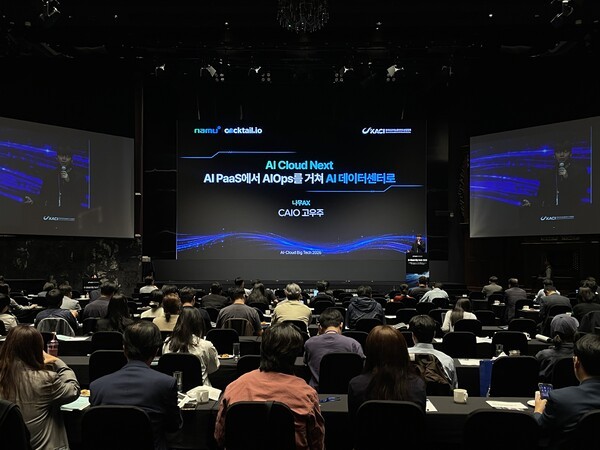
NamuAX Executive Director Ko Woo-joo gave a presentation under the theme, "From AI Cloud Next and AI PaaS through AIOps to AI data centers," explaining the operating framework needed to expand AI use inside companies. Ko said GPU monopolization and different deployment methods by department lead to lower resource efficiency. He added that resource allocation by model, standardized deployment procedures, access rights management, and usage management are needed.
NamuAX plans to expand its business scope to AI data centers in the future. To that end, it is pushing ahead with plans to expand cooperation in domestic NPU technologies, server technologies, and modular data center technologies. Based on such expanded cooperation, NamuAX aims to broaden its business into the data center sector and, in the long term, connect training and simulation infrastructure with inference and control environments at industrial sites before expanding into physical AI data centers.
Ko said the condition for sustained enterprise AI use is a stable supply of models and resources needed for work. He said the company will promote the advancement of operational technology tailored to customer environments and expand the scope of application to data centers and industrial sites.
Meanwhile, Polaris Office, which also participated in the event, announced an "Agent-Ready SaaS" strategy. The strategy aims for AI agents to directly use enterprise data and software. Polaris Office is extending SaaS into a work execution layer by designing it so AI agents can handle processes from document writing and approvals to registration in business systems.
Lee Hae-seok, vice president and group CAIO at Polaris Office, said the spread of AI agents is expanding the range of software users from people to AI. He analyzed that as an environment takes shape in which people set goals and agents call up the necessary data and software, the role of SaaS that holds enterprise data and business procedures could also change.
In line with this, Polaris Office plans to connect documents, groupware, electronic approvals, and ERP based on API and MCP. It is integrating workflows by tying together the process from report writing to approval submission and then to reflecting the approved content in business systems as a single flow.
The company is pushing ahead with applying small language models (SLMs) that reflect industry- and organization-specific data and regulations for markets with high security requirements, such as public institutions and finance. It also plans to support AI use in on-device and internal network environments and establish a control framework that manages agents' data access scope, execution privileges, and organization-specific approval procedures.
The company is pursuing commercialization by combining Polaris Office document technology with the groupware and electronic approval capabilities of PolarisAI Handy. Based on this, it plans to apply AI functions to the business systems of existing public-sector and enterprise customers. It also plans to expand support from on-premises environments to cloud and SaaS environments for the business systems of existing public-sector and enterprise customers, in line with customers' security and operating environments.
Vice President Lee said that in the era of AI agents, the user of software expands from people to agents. He added that the company will establish an environment in which document technology, groupware, and business workflows are connected and AI agents can actually perform tasks.
Source: TECHWORLD · Kim Seung-gi
Original: https://www.epnc.co.kr/news/articleView.html?idxno=407757
References
This article was produced with the help of an automated content generation algorithm.
Source: TECHWORLD
Ver originalThis article was summarized and organized by BizCrush based on the original article from TECHWORLD. For exact quotations and full details, please refer to the original article.