Public Call Centers to Shift to AI, but Transparency and Accountability Come First
IT DAILY ·
✦ Resumen de IA
The government is pursuing the consolidation of decentralized public call centers under 110 and a shift to an AI-based counseling system by 2030.
At a National Assembly forum, participants said that because public call centers are the first point of contact for complaints, their role and nature, responsibility, protection of citizens' rights, and transparency should be considered first when introducing AI.
Through the 110 non-emergency consultation number integration project, the government plans to gradually integrate general consultations from central administrative agencies into 110 starting in September, provide guidance and transfer services for 697 consultation numbers by 2027, and push for one-stop linkage by 2028.
As telecom company-led call centers continue to be reorganized around AICC, the government is also moving to consolidate the decentralized public call centers under the 110 umbrella. Along with efforts to integrate public consultation channels centered on 110, the government is accelerating the push to shift to an AI-based counseling system by 2030, and it has already set an AI transition target for 2030.
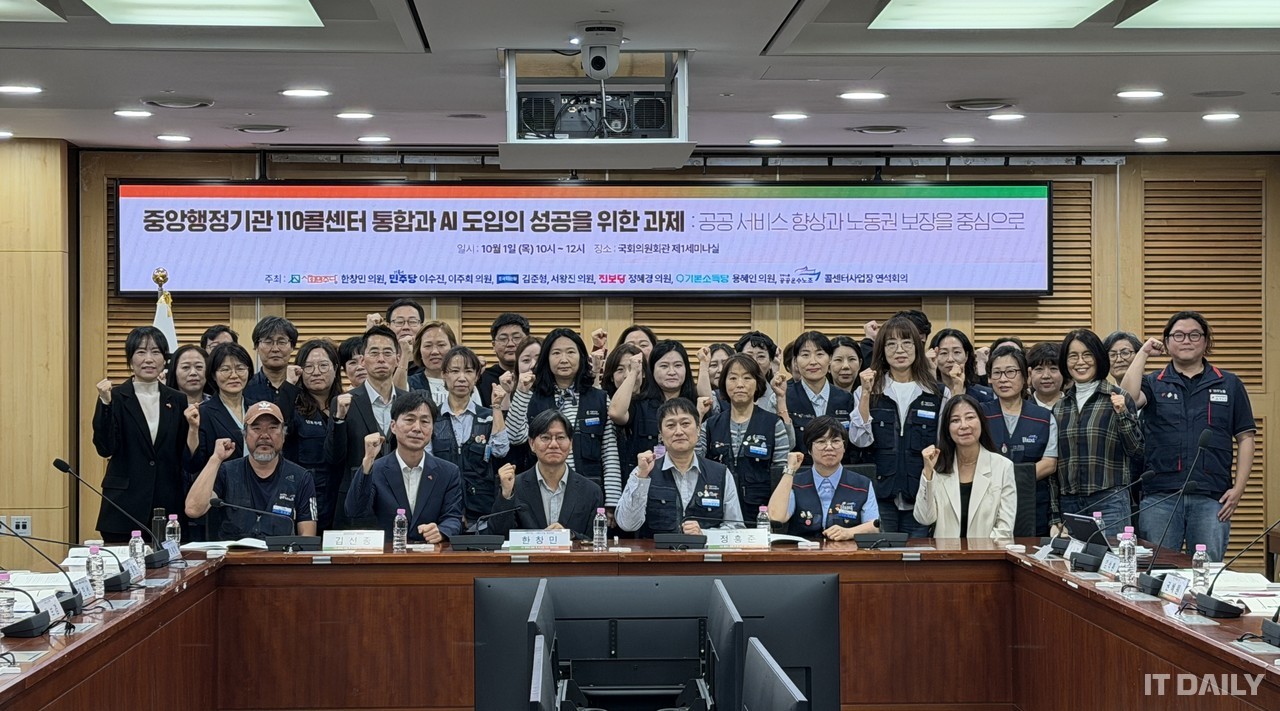
In connection with this, a National Assembly forum was held on the 1st. The forum was titled, "Tasks for the successful integration of central administrative agency 110 call centers and the introduction of AI."
Industry experts and officials pointed out that public call centers are the first point of contact for citizens seeking to raise complaints to the government. They emphasized that, in the process of introducing AI to public call centers, the role and nature of public call centers should be considered first, before a simple transition.
It was also noted that, when introducing AI into public call centers, responsibility for work outcomes and the protection of citizens' rights must be considered. Some also argued that a transparent operating system is needed when AI is introduced into public call centers.
The government is pursuing the "110 non-emergency consultation number integration project" to consolidate non-emergency consultation channels around 110. The project is handled by the "Task Force for Operating the 110 Integrated System for Non-Emergency Consultation Numbers" under the Anti-Corruption and Civil Rights Commission, and the task force carried out a pilot operation from May to August. The government plans to reflect improvements identified in the pilot and gradually integrate general consultations from central administrative agencies into 110 starting in September, and it plans to provide guidance and transfer services for 697 consultation numbers from central and public institutions through 110 by 2027.
Along with bringing general consultations under 110, the government also plans to expand the number of institutions using 110 as their main number. Institutions using the 110 main number include the Ministry of Agriculture, Food and Rural Affairs and the Ministry of Oceans and Fisheries, and the number of user institutions, currently 6, is expected to expand to 21 by the end of this year and to 34 by 2028.
However, 94 specialized consultation call centers, where integration may be difficult because they handle sensitive information or are linked to on-site actions, will be excluded from the consolidation target. Instead, the government plans to complete one-stop linkage between 110 and specialized consultation call centers by 2028 and also push ahead with AI transition by 2030.
The AI transition of public call centers is being pursued mainly through voice recognition, intent analysis-based consultation classification, and AI-based learning of policy information.
However, given the nature of public services, there are calls to avoid an introduction focused on efficiency and work automation, as in private-sector AICC systems.
Park Jae-beom, a research fellow at the Social Public Research Institute, identified the major issues in introducing AI to public call centers as a lack of transparency, unclear responsibility, bias from automation, and overreliance. He said citizens have difficulty understanding the basis for AI responses and complaint classification.
Park Jae-beom, a research fellow at the Social Public Research Institute, said the lack of transparency in the public sector is not just an inconvenience for users but also a matter of administrative accountability. In particular, he explained that if AI provides incorrect answers or misclassifies complaints, responsibility becomes unclear.
In such cases, the possible responsible parties include the AI developer, the system operator, the ministry in charge, and the counselors. However, it has been pointed out that if AI use expands without clear responsibility standards, it could lead to a responsibility gap.
As AI use expands in the public sector, concerns have been raised about overreliance on AI. It has been pointed out that public officials and counselors may trust AI recommendations and fail to detect errors, and that they may also use results containing errors as they are.
Lee Seon-myeong, head of the public servants' branch at the Anti-Corruption and Civil Rights Commission, said many citizens confuse which ministry is responsible for government-related complaints. He added that experienced counselors listen to the details of complaints and guide citizens to the appropriate agency, and that they provide accurate answers based on their understanding of complex administrative procedures and policies.
Participants suggested that the goal of introducing AI into public call centers should not be limited to work automation, productivity gains, and cost reduction. They also noted that many cases of private-sector AICC adoption have focused on improving operational efficiency and competitiveness, that private-sector AICC can bring changes in AI-based consultation automation, management, and evaluation methods, and that as a result, the workload of counselors may increase and employment may become less secure.
Concerns were raised about directly applying private-sector AICC adoption methods to public call centers. There were concerns that AI use centered on efficiency and productivity may have limits and that the characteristics of public services may not be sufficiently reflected. In particular, because public services are directly linked to citizens' rights, responsibilities, and complaint relief procedures, questions were raised about whether simply transplanting private-sector methods is appropriate.
In response, Park, the research fellow, suggested that governance for public AICC is needed. As elements of governance, he cited securing transparency and accountability, protecting digitally vulnerable groups, and considering the rights and interests of counseling workers. He also suggested that governance should take into account the participation of citizens and workers.
Hwang In-seon, head of the 110 Integrated System Operation Task Force at the Anti-Corruption and Civil Rights Commission, attended the event. Hwang explained that the core of the project is to integrate the system so that citizens can get help even if they do not know the phone number of a government ministry. He then said that the role and expertise of on-site counselors should be considered, and that he agreed on the importance of their role.
Hwang said it is necessary to provide sufficient training so that counselors can perform new tasks. He also mentioned the need to provide a knowledge management system and to establish a system for quickly delivering policy changes. In addition, he said he would review a linkage system for specialized consultations and consider the participation of on-site counselors in building AI services.
Source: IT DAILY · Seong Won-young
Original: https://www.itdaily.kr/news/articleView.html?idxno=241961
References
This article was produced with the help of an automated content generation algorithm.
Source: IT DAILY
Ver originalThis article was summarized and organized by BizCrush based on the original article from IT DAILY. For exact quotations and full details, please refer to the original article.