KT Pushes Hospital AX With 'Medical Standard Model' From Appointment Booking to Diagnosis
IT DAILY ·
✦ Resumen de IA
KT said it will pursue partnerships with major hospitals and general hospitals nationwide based on a "medical standard model" that integrates infrastructure, data platforms, and AI services tailored to each hospital's needs.
KT unveiled medical AI agents by area on the 1st and presented an AI patient assistant, AI voice bot, nursing schedule agent, operating room schedule agent, and clinical administration agent.
KT plans to combine medical specialist partner solutions with a medical data platform, hybrid cloud, and GPU computing infrastructure to expand the standard model into areas that support diagnosis, interpretation, and decision-making.
KT said it will pursue partnerships with major hospitals and general hospitals nationwide based on a "medical standard model" that integrates infrastructure, data platforms, and AI services tailored to each hospital's needs. KT also unveiled medical AI agents by area on the 1st.
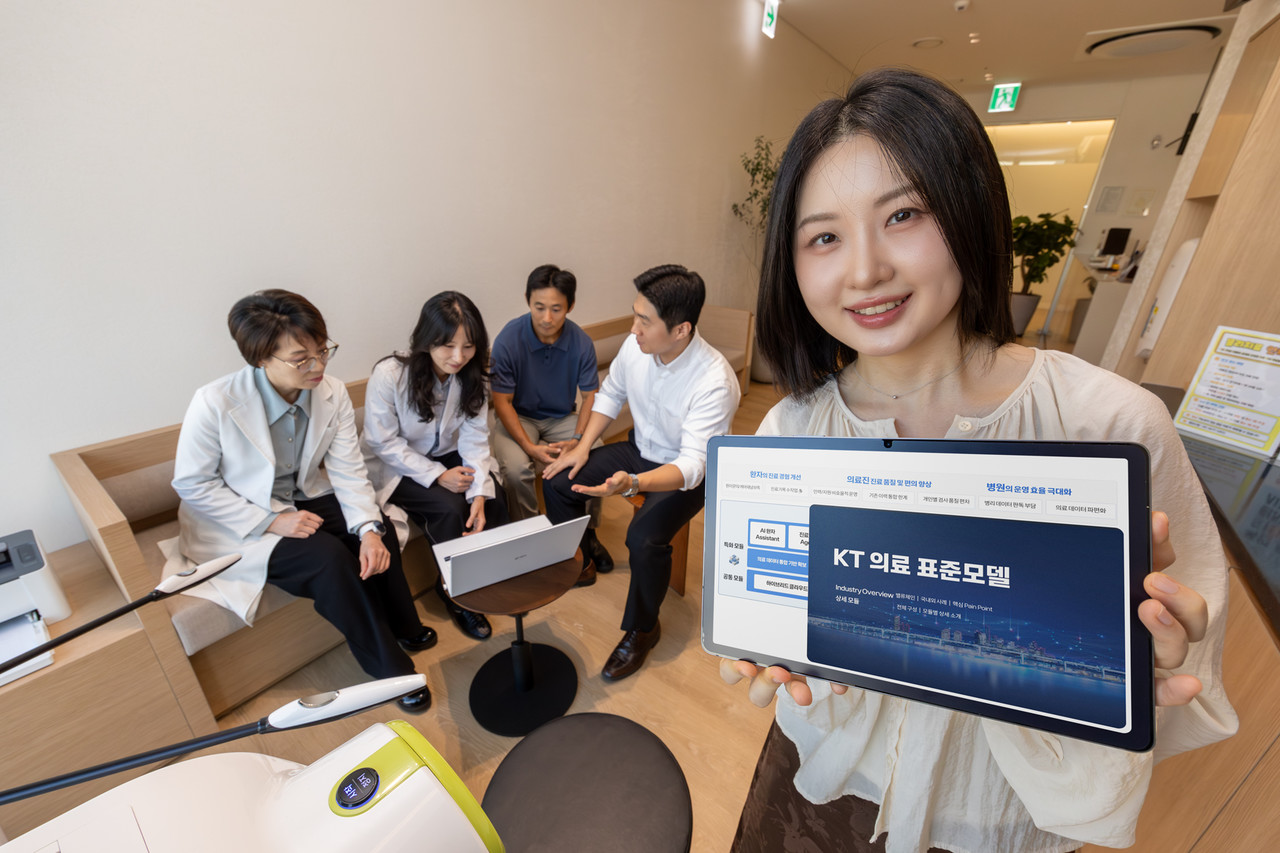
Related photos showed a KT employee explaining the "medical standard model" to hospital officials at a hospital in Seoul. KT said it will seek to expand hospital partnerships and introduce medical AI agents by promoting the "medical standard model," which bundles the elements each hospital needs.
The push comes as South Korea enters a super-aged society. As of this year, people aged 65 and older account for about 21% of the population, and demand for medical care is rising sharply as the number of chronic disease patients increases.
Medical costs are also climbing. As of 2024, chronic disease treatment accounts for 80% of total medical expenses.
In August, the government unveiled an "AI Basic Medical Strategy" jointly with relevant ministries. The goal of the strategy is health equity and sustainability, and the government is pursuing the elimination of gaps in regional, essential, and public healthcare and the spread of nationwide AI medical infrastructure as national tasks.
KT conducted customer analysis targeting hospital medical staff and management, and based on that analysis, identified AX areas applicable to the medical field to systematize the medical standard model. The analysis covered hospital-wide operations including patient guidance, clinical administration, staffing, facility operations, and the use of medical data.
The AX model aims to improve the patient care experience, enhance the quality and convenience of care for medical staff, and support more efficient hospital operations. Among the medical standard model offerings, KT introduced an AI patient assistant for improving the patient care experience, and the tool can improve accessibility throughout the care process by providing AI support functions at patient touchpoints such as reservations, guidance, and confirmations.
KT also uses an AI voice bot to automatically handle inquiries 24 hours a day and support symptom-based appointment intake and post-discharge care guidance. KT plans to add a medical knowledge-based retrieval-augmented generation (RAG) function to the AI voice bot in the first quarter of next year.
In addition, KT will provide a nursing schedule agent and an operating room schedule agent, while also pursuing the deployment of a medical data platform. The nursing schedule agent, operating room schedule agent, and medical data platform are designed to optimize medical staff work, and the medical data platform has functions for collecting and storing hospital data such as electronic medical records, medical images, tests, and research data, as well as standardizing and linking them based on healthcare information exchange standards.
KT will unveil a "clinical administration agent" service to improve hospital operations. The service recognizes and analyzes doctor-patient consultations and writes clinical notes based on medical terminology and abbreviations. It can also reflect department-specific templates and forms, link with electronic medical records after medical staff review and approval, and link with testing and prescription systems after medical staff review and approval. Through this, it automates tasks from writing medical records to order and billing administration.
KT plans to combine medical specialist partner solutions with a medical data platform, hybrid cloud, and GPU computing infrastructure. Based on this, it plans to expand the standard model into areas that support medical staff diagnosis, interpretation, and decision-making.
Examples of such expansion include an "AI cancer diagnosis CDSS" and "AI endoscopy interpretation." The "AI cancer diagnosis CDSS" presents clinical guidelines and treatment evidence based on integrated patient clinical and imaging information. "AI endoscopy interpretation" analyzes endoscopy images in real time during examinations, with the aim of improving lesion detection rates and standardizing interpretation quality.
Based on the expansion of the standard model, KT will pursue the AI Basic Medical Strategy and, as part of that process, plans to participate in the AI-specialized hospital project to verify whether its services are suitable for hospital environments and to expand the scope of service deployment.
Source: IT DAILY · Seong Won-young
Original: https://www.itdaily.kr/news/articleView.html?idxno=241943
References
This article was produced with the help of an automated content generation algorithm.
Source: IT DAILY
Ver originalThis article was summarized and organized by BizCrush based on the original article from IT DAILY. For exact quotations and full details, please refer to the original article.