What Counts as an AIDC? Enforcement Decree of Special Law to Decide Fate of Power and Homegrown NPUs
IT DAILY ·
✦ AI Summary
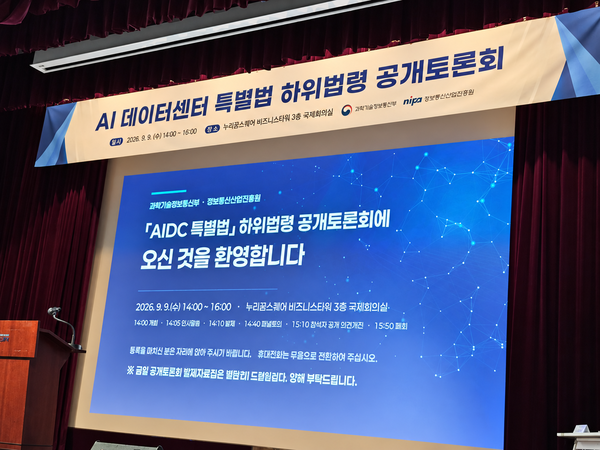
The Ministry of Science and ICT held a public discussion on drafting subordinate legislation for the "Special Act on the Promotion of the Artificial Intelligence Data Center Industry" at Nuri Dream Square in Mapo-gu, Seoul, on the 9th.
The discussion focused on key issues including AIDC recognition criteria, power exemptions, permit exemptions, and who should receive government support.
There were concerns that defining AIDC only by power consumption and the share of AI equipment could exclude existing data centers, inference facilities, and domestically made NPUs, along with calls to reflect actual implementation feasibility and the timing of power supply.
The Ministry of Science and ICT on the 9th held a public discussion on drafting subordinate legislation for the "Special Act on the Promotion of the Artificial Intelligence Data Center Industry" at Nuri Dream Square in Mapo-gu, Seoul. The event photo was taken by Reporter Lee Jae-young.
At the discussion, the definition of AIDC was handled as a key agenda item in the enforcement decree of the AIDC special law. Because the scope of facilities recognized as AIDC determines power exemptions, permitting exemptions, and eligibility for government support, the criteria for what facilities should be regarded as AIDC emerged as a core issue in drafting the enforcement decree.
The criteria for recognizing AIDC are expected to affect not only power issues but also the domestic AI semiconductor and data center equipment ecosystem. In particular, concerns were raised that if the criteria are applied around the absolute power consumption of AI equipment or the share of AI equipment power in total ICT equipment power, domestically made NPUs with high power efficiency could be disadvantaged.
At the public discussion on drafting subordinate legislation for the AIDC special law, participants pointed out in connection with power exemption discussions that the real issue is not the exemption from review itself, but the actual timing of power supply. It was also noted that a power-review exemption alone does not guarantee power supply at the place and time desired by operators.
Accordingly, a broader scope for facilities eligible for special treatment was raised as a necessary measure. There was also a push to identify operators with actual implementation capabilities and to block phantom demand aimed at securing power capacity first.
These issues were discussed as matters to be reviewed before enforcement at the public discussion on drafting subordinate legislation for the AIDC special law, held by the Ministry of Science and ICT on the 9th at Nuri Dream Square in Mapo-gu, Seoul. The formal name of the AIDC special law is the Special Act on the Promotion of the Artificial Intelligence Data Center Industry, which was promulgated on June 9 and will take effect on March 10 next year. The discussion covered the scope of AIDC recognition, reporting for construction and operation, one-stop processing for permits and approvals and facility exemptions, power-related exemptions, and procedures for designating special zones and providing support.
Because consultations with relevant ministries were still underway, the government withheld specific draft enforcement-decree provisions from public disclosure that day, and the scale of power exemptions to be applied was also not disclosed.
The government proceeded with the discussion by presenting the basic direction and issues of the system before hearing opinions from industry, academia, and research institute representatives.
At the session, lawyer Song Do-young, head of the research task force for the AIDC special law subordinate legislation, presented a draft framework for the subordinate legislation.
The agenda items presented at the discussion converged on the criteria for recognizing AIDC. That is because the premise for applying support and special treatment under the special law is whether the facility qualifies as AIDC under the enforcement decree.
As criteria for distinguishing between general data centers and AIDC, the power consumption of AI accelerators such as graphics processing units (GPU) and NPUs, as well as the share of AI equipment in total ICT equipment power, were put under review.
It is difficult to define AIDC based on power alone. Data center power is used not only for ICT equipment such as servers and storage, but also for infrastructure such as cooling, air conditioning, and power conversion. For this reason, it is difficult to distinguish power used for AI computing from power used for cooling facilities based solely on total utility capacity.
In addition, different operators use different standards when announcing data center capacity, which was also raised as a problem. The total utility power capacity supplied to the facility and the IT load actually used by ICT equipment are not the same thing. Therefore, depending on which benchmark is chosen, whether the same facility is recognized as AIDC could change.
To reduce this confusion, it is necessary to specify the scope of power consumption calculations when determining AIDC. It is also necessary to specify the timing of measurement when determining AIDC. In addition, the method for confirming the power used by AI equipment when determining AIDC needs to be specified.
There were also calls to reflect the difference between data centers for AI training and those for inference in the recognition criteria. The point was made that the criteria for determining AIDC need to be refined because data center power is used across multiple types of equipment and because capacity standards differ by operator.
Training facilities for developing large-scale AI models have a high share of GPU and other AI accelerators and are characterized by high power density. By contrast, inference centers that provide actual services often operate existing CPU servers, storage, and network equipment alongside AI accelerators. As a result, training facilities and inference centers differ in equipment configuration and power characteristics, so the share of AI accelerators does not appear at the same level.
In cases where GPU is added to an existing cloud data center to provide AI inference services, the share of AI accelerators in total ICT equipment may be lower than in training facilities. For that reason, there were concerns that if the share of AI equipment is applied uniformly, actual AI-service inference facilities may not be recognized as AIDC.
Data center operations are not limited to a single use such as training or inference. A single facility can provide both general cloud services and AI services at the same time, and it is also possible to expand AI equipment step by step in line with customer demand.
In this connection, a problem was raised that there may be a gap between the share of AI equipment anticipated at the design stage and the actual share after customers move in. Private data centers have the characteristic that equipment configuration and customer composition change in response to market demand, making it difficult to determine AIDC status based only on the power share at a specific point in time.
A panel discussion was held at the "Public Discussion on Subordinate Legislation for the AIDC Special Law." The photo credit was given as Reporter Lee Jae-young. The discussion that day covered the impact of AIDC recognition criteria on the domestic AI semiconductor industry.
The focus of the discussion was the problems that could arise if AIDC criteria are centered on power consumption. As background, differences in computing performance and power consumption among accelerators were cited.
Because of these differences, concerns were raised that applying an absolute power-consumption standard could disadvantage equipment with higher power efficiency. The possibility that higher power efficiency could paradoxically lead to exclusion from AIDC was also presented as the gist of the point.
A representative from Rebellions argued that it is necessary to consider the power density of each AI accelerator. The person also pointed out that excluding facilities that use high-efficiency, low-power-consumption accelerators from AIDC would be inappropriate.
There were also concerns that if the standard is set only by the power consumption of AI accelerators, domestically made NPUs that deliver the same computing performance with less power could be disadvantaged in the system. A high-power GPU, compared with a domestically made NPU, was cited as the benchmark. It was also noted that equipment that improves energy efficiency could find it harder to meet the AIDC recognition criteria.
There were objections to distinguishing AIDC solely by power consumption or designing the system around specific equipment. It was also pointed out that applying different power standards by accelerator could make the enforcement decree more complex. Concerns were also raised that designing the system around specific equipment could limit its ability to respond to market changes as AI semiconductor technology and product performance evolve rapidly.
Accordingly, it was suggested that when establishing AIDC recognition criteria, factors beyond simple power consumption should be considered together. Specifically, the direction suggested was to reflect the equipment's computing performance, energy efficiency, and the facility's actual purpose of use.
The discussion also noted that AIDC is a facility combining equipment and technologies such as AI accelerators, servers, storage, high-density power equipment, cooling devices, and networks. At the same time, the high reliance on foreign products for AIDC equipment was raised, and it was also pointed out that for high-priced core equipment used in data centers, foreign-made products are used in many cases.
The discussion also noted that domestic capabilities in building data centers are growing. It was also mentioned that related companies are pursuing overseas expansion. In addition, the increase in data center construction was presented as another point.
However, because AIDC is made up of the combination of various core equipment, it was suggested that if dependence on foreign-made core equipment continues apart from the expansion of construction, there may be limits to how investment effects translate into growth in the domestic industrial ecosystem.
At the discussion, it was emphasized that it is important to use the special law as a trigger to build the foundation for the domestic AIDC industry and the growth of domestically made equipment. Related organizations, including the Korea Data Center Association, have also continued discussing how to activate the industrial ecosystem.
However, at the discussion that day, no mandatory domestic-equipment usage ratio, priority procurement for domestic equipment, subsidies, or tax credits were presented. The discussion mentioned the direction of using the special law to create conditions for the growth of the AIDC industry and domestically made equipment, but it did not go as far as specific measures to support localization.
Instead, concerns were raised that the AIDC recognition criteria to be included in the enforcement decree should not disadvantage domestically made AI semiconductors and equipment. This discussion remained at the level of raising issues related to the AIDC recognition criteria to be included in the enforcement decree.
The key special treatment discussed together was the power-review exemption for AIDC located outside the Seoul metropolitan area. At the discussion, it was stressed that the power-review exemption and actual power supply should be viewed separately.
Power review is a procedure that checks in advance the impact of large-scale power-consuming facilities on the regional power grid. It was explained that while a power-review exemption can reduce the time and procedures for review, it does not mean that the power required by AIDC will be supplied automatically.
The government side explained that the purpose of the power-review exemption is to shorten the review process. It added, however, that separate conditions and procedures must be met in order to actually use power. It said that even facilities exempted from power review must negotiate and contract with Korea Electric Power Corporation and must also have the necessary power infrastructure in place.
For that reason, it was pointed out that if a data center construction plan, AI equipment introduction schedule, and power supply plan do not align, then even if the review process is shortened, it would be difficult to bring forward the actual start of operations. The point was that a power-review exemption alone does not automatically guarantee an earlier operating date.
In particular, AIDC was described as a facility whose power use can change sharply depending on AI training and inference workloads. Accordingly, it was also noted that a power-review exemption does not exempt an AIDC operator from obligations to maintain grid stability. There were also calls to manage the impact of abrupt load changes on the power grid.
At the same time, a participant in the discussion said that more than 70% of domestic data centers are located in the Seoul metropolitan area. Based on that, a proposal was made to review ways to use the AI infrastructure of existing facilities. There was also an argument that cases of converting existing data centers into AIDC should be included in the recognition criteria, not just new construction.
Existing centers were described as already having basic infrastructure such as buildings and telecommunications networks. For that reason, it was said that adding AI accelerators and related facilities to existing centers could provide computing resources faster than building new centers. A plan to convert existing data centers into AI infrastructure was also presented as a subject for review.
As Kim Kyung-man, head of the AI Policy Bureau at the Ministry of Science and ICT, delivered opening remarks at the "Public Discussion on Subordinate Legislation for the AIDC Special Law," concerns were raised that securing power is a greater constraint than space in the conversion and expansion of existing data centers.
It was pointed out that even if an existing data center has spare server space, it is difficult to install GPU and NPU if additional power cannot be secured. Power was also described as a bottleneck in the process of converting existing centers into AIDC.
It was also suggested that when an existing center with a low share of AI equipment gradually expands its accelerators, it may not meet the AIDC recognition criteria from the start.
For that reason, it was pointed out that if the subordinate legislation is based mainly on large-scale new construction facilities, it could make it difficult to expand AI infrastructure by utilizing existing data centers.
There was also an opinion that before providing power and permit-related exemptions, it is necessary to verify whether operators have actual implementation capabilities. It was noted that if an AIDC operator secures power capacity and then does not proceed with investment, it could hinder other operators from using limited power-supply opportunities.
There was also a view that it is necessary to block the possibility that operators lacking actual implementation intent, customers, or financing capability could use special treatment to secure power capacity first.
The government explained that, in order to screen out phantom demand, consistency is needed among power plans, KEPCO contracts, operators' facility construction plans, and AI equipment introduction plans. It also mentioned a measure to restrict operators that fail to advance their business for a certain period after receiving special treatment, as well as a measure to reclaim the special treatment. However, it was also stated that restricting operators or reclaiming special treatment raises issues of possible limits on business freedom and property rights, and that a clear legal basis is required for such measures.
As the key issues for the AIDC special law enforcement decree, the scope of facilities recognized as AIDC and the scope of operators eligible for special treatment were presented. It was noted that narrowing the recognition scope could exclude existing data centers, inference facilities, and high-efficiency domestically made NPUs.
Conversely, it was also compared that overly expanding the recognition scope could include general data centers in the special treatment and could also include operators with no actual investment capability.
Accordingly, the discussion converged on the need to avoid distinguishing AIDC solely by power consumption and the share of AI equipment, and instead establish criteria that reflect facility purpose, computing performance, energy efficiency, phased investment plans, and actual implementation feasibility. It was also suggested that these factors need to be judged together.
Kim Kyung-man, head of the AI Policy Bureau at the Ministry of Science and ICT, said the AIDC special law is a law that affects the pace of expanding domestic AI infrastructure. He added that it is important to prepare the subordinate legislation so that it works effectively in the field, and said the ministry plans to reflect the opinions presented that day in the subordinate legislation. He also said the ministry plans to maintain close communication with the industry during the remaining legislative process.
Source: IT DAILY · Lee Jae-young
Original: https://www.itdaily.kr/news/articleView.html?idxno=241508
References
This article was produced with the help of an automated content generation algorithm.
Source: IT DAILY
View originalThis article was summarized and organized by BizCrush based on the original article from IT DAILY. For exact quotations and full details, please refer to the original article.