[Information Security Solutions Conference] AI Reshapes the Security Landscape... Threat Diagnostics and Response Strategies Gather in One Place (Roundup)
IT DAILY ·
✦ AI Summary
It was explained that as AI spreads across data centers and workplaces and AI agents autonomously manipulate systems, the number of protected assets is increasing and the attack surface is expanding.
As a result, the limits of conventional security were raised: perimeter defense and pattern detection alone make it difficult to control data leaks, block internal spread, and control AI's autonomous behavior.
At the '2026 Information Security Solutions Conference' held on the 9th, an AIDC security framework, Micro-Segmentation, generative AI security, AI-DLP, and AI agent control measures were introduced.
As AI spreads across data centers and workplaces, and AI agents enter the stage of autonomously operating systems, the number of assets requiring protection is rising and the attack surface is expanding. At the same time, the limits of conventional security have become clear. It was explained that perimeter defense and pattern detection alone make it difficult to control data leaks, prevent internal spread, or manage AI's autonomous behavior, creating a need for new security strategies suited to the AI era.
Against this backdrop, Computerworld/IT DAILY held the '2026 Information Security Solutions Conference' on the 9th at EL Tower in Yangjae-dong, Seoul. The event theme was 'AI for Security, Security for AI.' Speakers continued the discussion by introducing security trends for the AI era.
The speakers introduced a security framework for AI data centers (AIDC) and also explained 'Micro-Segmentation,' a core element of zero trust. They also presented generative AI security strategies. Meanwhile, photos from the '2026 Information Security Solutions Conference' held on the 9th at EL Tower in Yangjae-dong, Seoul were released, with photo credit to Computerworld/IT DAILY.
The '2026 Information Security Solutions Conference' was held on the 9th. Photo credit: Computerworld/IT DAILY. At the event, Lee Won-tae, head of the Security Special Committee of the National AI Strategy Committee, delivered congratulatory remarks.
Before the keynote, Lee Won-tae, head of the Security Special Committee of the National AI Strategy Committee, and Kim Jin-soo, chairman of the Korea Information Security Industry Association (KISIA), delivered congratulatory remarks. The two pointed to AI's dual nature, noting that AI is both a powerful security tool and a new object of protection. They also emphasized the need for a security framework that can respond to technological progress and for an information security industry ecosystem.
Lee then explained how AI can be used in security. He said AI can analyze vast amounts of security data, detect anomalies early, identify vulnerabilities early, and automate response.
He also pointed out the risks of high-performance AI models. He said such models could increase the speed and scale of cyberattacks, and stressed that the scope of security measures should be expanded to cover AI models, data, infrastructure, and the supply chain as a whole.
The '2026 Information Security Solutions Conference' was held on the 9th. At the event, Lee said the direction of security needs to shift from post-incident response to proactive and predictive security that finds and blocks vulnerabilities before attackers do.
He also explained that zero trust and the National Network Security Framework (N2SF) need to evolve in a way that continuously verifies and controls AI agents and non-human identities.
Kim Jin-soo, chairman of the Korea Information Security Industry Association, delivered congratulatory remarks at the event. He said that amid AI's broad transformation of industries, there is a need to think about trust and security alongside technological and network advances. He stressed that security is not the cost of responding after an incident, but the basic infrastructure of an industry that makes new technologies and new services possible. He added that security is an investment for competitiveness.
Kim explained that for the information security industry to grow, there needs to be a foundation that connects technology capabilities with the field and the market. He also said demand-side companies and security companies need to understand each other's needs, and that field feedback should be reflected in policy. He further emphasized a virtuous cycle in which advanced technologies move through verification and commercialization and then lead to overseas expansion. Photo: Computerworld/IT DAILY.
Regarding the association's role, Kim said it would strengthen listening to field opinions. He also said it would push to connect the information industry and security companies, and work to create new markets and business opportunities through that effort.
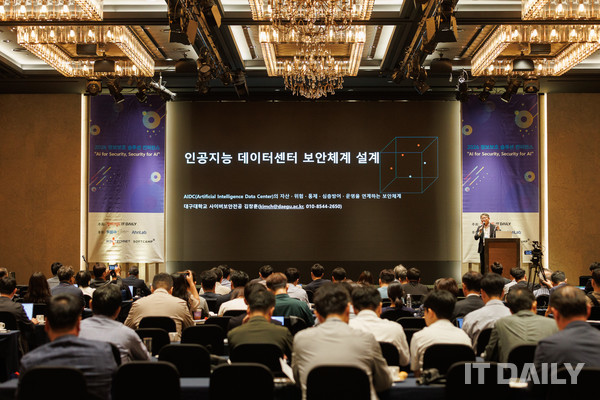
These discussions continued at the '2026 Information Security Solutions Conference' held on the 9th. At the event, Professor Kim Chang-hoon of Daegu University delivered the keynote speech.
The theme of Professor Kim Chang-hoon's keynote was 'AI-Specific Services for Security in AI Data Centers (AIDC).' Photo credit was listed as Computerworld/IT DAILY.
Professor Kim Chang-hoon said a national cyber security framework is needed to respond to the AI era. He diagnosed a growing imbalance with the existing principle of separating assets and domains for protection as AI-driven data linkage and sharing expand.
He explained that in AIDC environments, data transfer methods that do not pass through the CPU and OS can be used. He also said that communication between RDMA and GPUs could become a new threat vector. Accordingly, he stressed that AIDC security needs more granular separation and protection.
On the premise that security frameworks across AI services and infrastructure are lacking, Professor Kim proposed an AIDC cyber security framework. The framework's benchmark axes consisted of three elements: protected objects, location, and attackable security attributes.
Based on this framework, he analyzed threats across the infrastructure, cloud, and AI layers and organized them from the perspectives of confidentiality, integrity, and availability. He also said that 87 threats were modeled during the framework-building process, and that the results confirmed that AI threats are numerous and concentrated in the data domain.
As a future task, Professor Kim proposed scoring the analysis results to determine protection priorities. He also said SOC should integrate information by layer to identify relationships among attack behaviors. He added that if the connection domain expands through AI, the risk of damage spreading within internal networks increases, and said security in the AI era requires more granular response. He also pointed out that cyber security is receiving less attention than AIDC, and said he hopes such concerns will be reflected in future national policy.
At the '2026 Information Security Solutions Conference' held on the 9th, Choi Young-chul, CEO of SGA Solutions, gave a presentation. The topic was 'Redesigning the Cybersecurity Framework in the AI Era: Server Security and a Security Deployment Strategy Based on Micro-Segmentation.'
CEO Choi Young-chul presented Micro-Segmentation as a way to minimize damage in the era of AI attacks. In his presentation, he emphasized Micro-Segmentation as a security redesign approach to respond to the AI attack environment.
Micro-Segmentation was presented as a core element of zero trust architecture. It was explained as a method that separates communications by work, system, and workload units instead of relying on internal and external physical boundaries, with the goal of blocking the spread of internal damage once a breach occurs.
As the basis for this explanation, CEO Choi cited the U.S. Department of Defense's 'Zero Trust Reference Architecture (ZTRA).' He said it is a structure that blocks and controls all internal communications and allows only necessary connections after strict authentication.
As a security implementation method, the event presented a plan to first segment the network at a macro level and then add fine-grained controls. Virtual machines (VM), which are difficult to protect with firewalls alone, were cited as an example of fine-grained control targets. Photo credit: Computerworld/IT DAILY.
SGA Solutions' 'SGZ ZTA platform' protects three layers: server, VM, and container. At the server layer, it performs communication control and user access control. At the VM layer, it deploys policy enforcement points (PEP) for each VM, restricts application execution, and limits movement between workloads. At the container layer, it verifies resources throughout the entire development, deployment, and operations process and verifies execution behavior.
Referring to the fact that attack speed has accelerated and attack scale has expanded due to AI, CEO Choi said that when hacking cannot be avoided, it is necessary to focus on Micro-Segmentation as a strategy to minimize damage.
At the '2026 Information Security Solutions Conference' held on the 9th, Han Tae-dong, senior manager at AhnLab, gave a presentation. The topic was 'Is Your Prompt Safe? A New Standard for Enterprise Prompt Security in the Generative AI Era.' Photo credit was listed as Computerworld/IT DAILY.
Han Tae-dong, senior manager at AhnLab, pointed to the possibility of data leaks through prompts and said the key response is to use filtering and de-identification.
Speaking on 'Is Your Prompt Safe? A New Standard for Enterprise Prompt Security in the Generative AI Era,' Han said prompts have emerged as a new data leakage channel as generative AI becomes an everyday search tool. He explained that the spread of generative AI is also expanding the risk of leaking personal and confidential information outside the organization.
According to Harmonic's aggregate data, 8.5% of prompts entered into major generative AI tools contained personal, sensitive, or confidential information. One representative example was when users copied and pasted work materials and unknowingly entered personal or confidential information along with them.
He also explained that information in HTML comments, information in metadata, information in screen-hidden CSS areas, and hidden information in images are invisible to the human eye but can be read and used by LLMs. He noted that because of this characteristic, even information users did not intend to include can enter the prompt-processing process.
Han suggested that rather than blocking generative AI outright, input and output data should be selectively controlled. He said a full block could reduce work productivity. As a measure, he proposed routing internet access through a secure web gateway (SWG) without installing a program on the user's device. He said this would make it possible to filter prompts, block the leakage of personal and confidential information, block Prompt Injection, and manage usage history.
He advised that when using generative AI, a filtering system to block data leakage should be established as a basic control. He also said a de-identification system should be prepared when necessary. He further advised using enterprise-only services if possible. He also said a detailed logging system is needed for transparent history management.
These points aligned with the flow of presentations at the '2026 Information Security Solutions Conference' held on the 9th. At the event, a talk was given on 'Generative AI Utilization Strategies Based on a Safe AI Security Framework.' The speaker was Kim Ju-seop, director of the Cloud Strategy Business Division at WinsTechnet.
At the event, there was also a presentation under the subtitle 'Public AI Expansion... Building an N2SF Response System with AI-DLP.' Kim Ju-seop gave the presentation on that topic.
Kim Ju-seop stressed the need to establish a DLP framework specialized for generative AI in line with the expansion of AI adoption in the public sector. Photo credit was listed as Computerworld/IT DAILY.
Of 343 public institutions, 132 had built 381 AI-use and government-service cases, and Kim identified 5 major security threats associated with them. The threats he listed were sensitive information input and leakage, information leakage via attachments, unauthorized use of AI services, training data extraction, and Prompt Injection.
As a response framework, N2SF classifies work data and information systems by importance into Confidential (C), Sensitive (S), and Open (O) grades, and applies differentiated security controls by grade. As a condition for safely using generative AI, Kim cited securing visibility through recording and monitoring of input and output data. The main application areas of the N2SF information service model he presented were generative AI use in work environments, internet access from work terminals, and cloud-based integrated document systems.
Kim explained that conventional pattern- and signature-based security alone has limits in responding to threats in LLM- and GPU-based AI environments. As an alternative, he proposed AI-DLP. Functions required for AI-DLP include controlling sensitive information input and output in prompt and coding assistants, inspecting data movement through the Model Context Protocol (MCP), and checking for leakage risks in encrypted communication channels.
Kim explained that unauthorized transmission to external AI must be blocked and sensitive information exposure must be cut off at the source. He also said a means is needed to control data by context and attachment grade, and that visibility and transparency should be secured through AI-DLP.
These points were presented at the '2026 Information Security Solutions Conference' held on the 9th. Photo credit: Computerworld/IT DAILY.
At the session, Kim Dong-hoon, head of the Consulting Division at SoftCamp, gave a presentation on 'AI Security for the Use of Generative AI and AI Agents.' Kim stressed that in the age of AI agents, it is necessary to define control methods and the scope of permission in concrete terms.
Kim pointed to data control for preventing the external leakage of personal and confidential information as a major challenge in the existing generative AI phase. He then explained that AI agents not only read files but also make API calls and perform data modification and deletion.
He also said AI agents can access hundreds or several thousand files and system resources in a short time. He described AI agents as 'new privileged users.'
Existing IAM has assumed human hiring and departure, as well as account issuance and revocation, but has been criticized as insufficient for managing the identity and behavior of AI agents. In response, SoftCamp proposed registering an owner and work purpose for each agent and assigning a non-human identity (NHI). It also defined the management scope to include the full life cycle, including tokens, access scope, and privilege revocation.
SoftCamp said user privileges and AI agent privileges must be separated. It also proposed that the final access scope be determined based on the common allowed range among three elements: user privileges, agent privileges, and tool policy. As a central management location for personal access tokens and secret keys, it proposed an 'Shield AI Gateway.'
It then explained a control scheme by task risk level: allowing viewing, requiring approval for modification, and blocking deletion. As a PC control method, it proposed limiting access only to approved workspaces through a sandbox. Kim said the challenge is not whether to allow AI, but how to set the control method and permission scope, and that the goal is to ensure agents operate only within determined security policies.
Kim Ki-woong, head of the Security Strategy Response Team in the Information Security Department at KB Kookmin Bank, gave a presentation at the '2026 Information Security Solutions Conference' held on the 9th on AI attack simulations and response strategies in the financial sector. Photo credit was listed as Computerworld/IT DAILY.
Kim Ki-woong said security in the AI era is a speed race, and that the financial sector's security operations system needs to change. He explained that responses must be accelerated to match the speed of AI attacks.
He pointed out that AI is changing both the speed and scale of attacks. In the past, after a vulnerability was disclosed, time was needed to analyze the PoC and develop attack code, but he said AI agents have automated that process, shortening the time until actual attacks occur.
KB Kookmin Bank carried out AI-based automated web vulnerability checks and attack simulations to verify practical usability. As a result, AI proved effective in reducing the time needed to search for URLs, APIs, and parameters and in reducing the repetitive work of deriving candidate vulnerabilities.
However, AI showed limitations in understanding financial business logic, understanding complex authentication procedures, and judging the impact on actual transactions. Accordingly, he explained that human intervention will continue to be necessary in distinguishing false positives from actual vulnerabilities and in judging business impact.
As a way to narrow the speed gap between attackers and defenders, it was pointed out that not all vulnerabilities should be treated equally. Instead, vulnerabilities should be prioritized based on practical exploitability, publicly available attack code, whether they are exposed to the internet, and their relevance to critical assets, so that the targets for first response can be identified.
Accordingly, security checks must also move beyond one-off tasks, and a system is needed that repeats inspection, verification, detection, policy revision, and re-verification. The team head said the key is not the volume of AI adoption, but having an operational framework for verification and response that is faster than the attack speed amplified by AI.
Source: IT DAILY · Kim Ho-jun, Yang Seung-gab, Kim Byeong-ju, Seong Won-young
Original: https://www.itdaily.kr/news/articleView.html?idxno=241510
References
This article was produced with the help of an automated content generation algorithm.
Source: IT DAILY
View originalThis article was summarized and organized by BizCrush based on the original article from IT DAILY. For exact quotations and full details, please refer to the original article.